ScaleMatic — Proof Bank
ScaleMatic  ·  Proof Bank  ·  Why These Results Are Different

Outbound works.
Judgment is what scales.

ScaleMatic did not start as a software company. It started as an outbound problem. This is the record of what we built, what we learned, and what the results look like when judgment governs execution.

How We Got Here

We didn't set out to build software.
We set out to solve a judgment problem.

For years, we were running appointment-setting campaigns across LinkedIn and cold email. The challenge was never sending messages.

The challenge was deciding: who to contact, when to contact them, what to say, how to follow up, when to push forward, and when to hold back.

Most outbound systems focus on activity. We were obsessed with judgment. Because every conversation carries risk.

Push too hard and you damage trust. Follow up too aggressively and you look desperate. Automate the wrong thing and you create brand damage at scale.

So we started building our own process. Not because we wanted to build software — because nothing we found exercised real commercial judgment.

The workflow was entirely manual. Lead lists from Apollo and Sales Navigator. Manual research. Manual qualification. Manual segmentation. Manual message creation. Manual reply handling. Manual follow-up decisions.

Every campaign required operators constantly asking: "What is the next best move here?" — not "What is the next automated step?" That distinction became important.

The replies were never the problem. We were getting strong engagement.

The real bottleneck was everything that happened after the reply.
Understanding context. Interpreting intent. Deciding how to progress the conversation. Avoiding brand risk. Moving someone toward a meeting without sounding like every other salesperson in their inbox.

So we started building systems around the process. First came Apollo and Sales Navigator for sourcing. Then n8n to orchestrate workflows — pipelines that could ingest lead lists, score prospects, generate market research, identify relevant context, and create personalized outreach.

Then we connected Slack. Whenever a prospect replied, we wanted commercially intelligent guidance on the next best response — not generic AI outputs. Responses designed to move the conversation forward while preserving trust.

Then came HeyReach. Then dedicated infrastructure. Then custom workflows. Then more clients. Then more edge cases.

As results improved, complexity exploded.

Every new client introduced different ICPs, different buying journeys, different offers, different approval processes. The personalization worked. The results worked. But the operational overhead kept growing.

Personalization at scale became expensive. Managing multiple disconnected tools became fragile. Maintaining workflows became its own full-time job. And every improvement required another layer of duct tape.

Eventually we realized something.

We were no longer building outbound campaigns.
We were building commercial infrastructure.

The process had evolved into a system for commercial reasoning, conversation progression, trust preservation, human approval, and outbound governance.

At that point, continuing to stitch tools together stopped making sense. We wanted more control, more flexibility, more transparency, and most importantly — a cleaner way to govern outbound across every client, campaign, conversation, and channel.

That is when ScaleMatic was born. Not as an automation tool. Not as another outbound platform. As a governed execution layer — built around a belief we learned the hard way:

The future of outbound is not more automation.
It is better judgment.
The stack we built and eventually outgrew — before building ScaleMatic to replace it.
01
Sales Navigator
Prospect identification using hiring signals and commercial context — not title alone. The starting point for every campaign.
Limitation: manual, no enrichment or intent layer
02
Apollo.io
Data enrichment and cold email sequencing. Ran in parallel to LinkedIn for multi-channel coverage and contact data.
Limitation: no commercial reasoning, sequences not context-aware
03
n8n
The connective tissue. Orchestrated research, lead scoring, AI draft generation, approval queues, and CRM updates into one governed workflow.
Limitation: brittle infrastructure, constant maintenance, no native intelligence
04
Slack
Reply routing and human approval layer. When a prospect responded, operators received the context and a recommended next move — not just a notification.
Limitation: manual bottleneck at scale, inconsistent across operators
05
HeyReach
LinkedIn multi-sender automation with daily limits respected. Human review required before every outreach batch went live.
Limitation: no intelligence layer, governance entirely dependent on human time
06
ScaleMatic
Replaced the entire stack. Research, scoring, message generation, human approval, conversation progression, and learning loop — unified into one governed system.
Same judgment. A fraction of the overhead.

The old way

  • Multiple tools with no unified commercial view
  • Activity increasing while conversion stayed flat
  • Follow-ups triggered by timers, not context
  • Escalation before trust was established
  • Personalization expensive and unsustainable at scale
  • No visibility into where conversations were dying

Governed execution

  • Every prospect evaluated against commercial signals
  • Human approval before any message or escalation
  • Follow-up based on conversation context
  • Calls only when trust conditions are confirmed
  • Personalization governed and scalable
  • Full visibility into progression at every stage
Cold Email Campaigns  /  via Instantly
Cold Email · Instantly
B2B SaaS
$146K ARR in 60 Days
The Problem
Founder-led SaaS generating interest but struggling to create predictable sales conversations. Outbound was producing activity — not qualified opportunities.
What Changed
Narrowed targeting. Governed progression around buying signals and commercial context before escalating. Volume decreased. Quality increased.
What We Learned
Most SaaS founders don't need more outbound. They need better qualification before the first message. Activity was never the bottleneck. Relevance was.
23.2K
Emails Sent
1.88%
Reply Rate
113
Opportunities
31
Calls Booked
6
Closed Won
$1.13M
Pipeline Value
$146,000
New ARR Closed
Not a volume win. A judgment win.
B2B SaaS
Instantly · Sep–Nov 2025
Cold Email · Instantly
Agency / B2B SaaS
$120K ARR Pipeline
The Problem
Outbound at moderate scale with inconsistent pipeline quality. Responses were coming in but positive signal was low — too many unqualified conversations making it into the calendar.
What Changed
ICP tightened significantly. Messaging shifted from product-first to problem-first. Positive reply rate reached 56.2% — over half of replies expressed genuine buying intent.
What We Learned
Positive reply rate matters more than raw reply rate. A 3% rate with 56% positive signal outperforms 6% with 20% positive. Most campaigns optimize the wrong metric.
5,072
Sequence Started
3%
Reply Rate
56.2%
Positive Reply
86
Opportunities
27
Meetings
$860K
Pipeline Value
$120,000
ARR Pipeline Generated
56.2% positive reply. Quality, not volume, drove this.
Agency SaaS
Instantly · Jan 5–16, 2026
Cold Email · Instantly
Private Equity
$50K/Year Contract Closed
The Problem
$1B+ PE firms are notoriously resistant to cold outreach. Standard volume approaches fail completely. Trust threshold is extremely high and reputation risk is real.
What Changed
Volume reduced dramatically. Research depth per contact increased. Outreach only sent when commercial timing and relevance aligned precisely. 38.5% of replies were positive.
What We Learned
In high-trust markets, the cost of a wrong message exceeds the cost of a missed send. Selectivity creates credibility. Credibility creates access.
2,298
Contacts
1.1%
Reply Rate
38.5%
Positive Reply
10
$1B+ PE Firms
4
Calls Booked
1
Contract Closed
$50,000/yr
Contract Value Closed
Selectivity created the credibility that created the contract.
Private Equity
Instantly · Nov 10–13, 2025
Cold Email · Instantly
E-Commerce
$80K ARR Closed
The Problem
E-commerce operators are saturated with vendor outreach. Generic automation gets ignored immediately. Trust windows are extremely short.
What Changed
Messaging anchored to specific operational pain. Timing matched to buying signals — hiring activity, growth announcements, platform changes. 3 deals from 35 opportunities.
What We Learned
In saturated markets, the first message earns the right to a second. Precision is the only path.
4,557
Contacts
2.8%
Reply Rate
27.8%
Positive Reply
35
Opportunities
15
Calls Booked
3
Deals Closed
$80,000
ARR Closed
Saturated market. Precision was the only path.
E-Commerce
Instantly · Oct 12–18, 2025
Patterns Across 244 Opportunities

What the data kept teaching us.

Across four verticals, two channels, hundreds of conversations — the same patterns kept emerging. These aren't hypotheses. They're observations from campaigns that ran.

Pattern 01
The best campaigns sent fewer messages than expected.
Every time we increased selectivity — tightening ICP, raising research depth before sending — pipeline quality improved. Volume was never the constraint. Relevance was.
Implication: more outbound rarely fixes a pipeline problem.
Pattern 02
Reply quality mattered more than reply volume.
A 3% reply rate with 56% positive signal consistently outperformed a 6% rate with 20% positive. Most systems optimize raw reply rate. That optimizes the wrong metric.
Implication: positive reply rate predicts revenue. Reply rate doesn't.
Pattern 03
Trust increased when outreach became more selective.
Counterintuitively, sending less — but with better timing and relevance — increased perceived credibility. Prospects responded differently to outreach that clearly understood their situation.
Implication: selectivity is a trust signal, not a limitation.
Pattern 04
Conversion gains came from follow-up governance.
Better copy helped. But the biggest improvements came from governing when and how follow-up happened — context-aware, not timer-triggered. The difference was judgment, not wording.
Implication: follow-up timing matters more than follow-up copy.
Pattern 05
Commercial timing outperformed message optimization.
Reaching out during a hiring surge, a funding event, or a leadership change converted at 2–3x the rate of identical messages sent outside those windows. Timing is the highest-leverage variable.
Implication: when you reach out matters more than what you say.
Pattern 06
The pipeline leak was in the middle stages.
Most systems are good at generating first replies. Very few advance from rapport to pain to consequence. That's where 70% of deals were dying — not at the opener, not at the CTA.
Implication: conversation progression is the real constraint in most pipelines.
LinkedIn Execution  /  One Screenshot Per Sender

Eight senders. Every one documented.

Every LinkedIn campaign required human approval before any message sent. One screenshot per sender — the best representative period for each. No cherry-picking between periods to inflate numbers.

All data from HeyReach. Governed through approval queues at every step.

Kalei Poteat
Mar 1–7, 2026
101
Connections
51.5%
Accept Rate
38
Msgs Sent
86.8%
Reply Rate
86.8% reply — highest on record
Strongest single-week reply rate across all senders and all time periods.
Kalei Poteat
Daniel W. Sharpe
Nov 6–12, 2025
151
Connections
33.8%
Accept Rate
28
Msgs Sent
53.6%
Reply Rate
53.6% message reply rate
High reply rate in a competitive niche. Governance kept quality consistent across a tight send window.
Daniel W. Sharpe
Matthew Ramsden
Nov 6–12, 2025
55
Connections
61.8%
Accept Rate
40
Msgs Sent
30%
Reply Rate
61.8% connection accept rate
61.8% connection acceptance — well above LinkedIn benchmarks. Targeting precision drove this, not volume.
Matthew Ramsden
Roger Nikunen
Jan 5–11, 2026
150
Connections
40%
Accept Rate
42
Msgs Sent
52.4%
Reply Rate
52.4% message reply rate
52.4% reply rate from a cold start. Consistent results within the first active week of the campaign.
Roger Nikunen
Megan Verdun
Nov 1 – Dec 26, 2025
428
Connections
39.3%
Accept Rate
157
Msgs Sent
33.1%
Reply Rate
33.1% reply over 8 weeks
Maintained above-30% reply rates across a full two-month campaign. Consistency is the hardest thing to sustain.
Megan Verdun
Brad Cavanaugh
Jan 14–20, 2026
143
Connections
37.1%
Accept Rate
91
Msgs Sent
30.8%
Reply Rate
30.8% message reply rate
30.8% reply rate within 6 days of launch. Governed from day one — no ramp-up period needed.
Brad Cavanaugh
John Sr. — Auctus AI
Jan 1 – Mar 2, 2026
684
Connections
21.5%
Accept Rate
114
Msgs Sent
36.8%
Reply Rate
36.8% reply over a full quarter
Longest continuous campaign. 36.8% reply rate sustained across a full quarter with multiple ICPs tested.
John Sr. — Auctus AI
Daniel Sharpe
Sep 1 – Dec 26, 2025
1,362
Connections
36.2%
Accept Rate
311
Msgs Sent
32.2%
Reply Rate
32.2% reply across 1,362 connections
4-month long-run data. Maintaining 36% acceptance and 32% reply at this volume is a governance achievement.
Daniel Sharpe

Aggregate — All Senders Combined

Oct–Dec 2025 multi-sender view. Consistent governance across a full quarter of campaigns.

997
Connections
42.3%
Accept Rate
320
Msgs Sent
37.8%
Reply Rate
42.3% accept · 37.8% reply across all senders Aggregate

Calls completing. Not just booking.

70 completed calls in a single tracked period — up 40% from prior 30 days. 86% show rate. Conversations convert when outbound earns them rather than forces them.

70 completed · +40% growth · 86% show rate Calendly analytics
Client Testimonials  /  In Their Own Words

Hear it from the people running it.

Founders and operators sharing what governed outbound actually looks like — unscripted. Click any video to play.
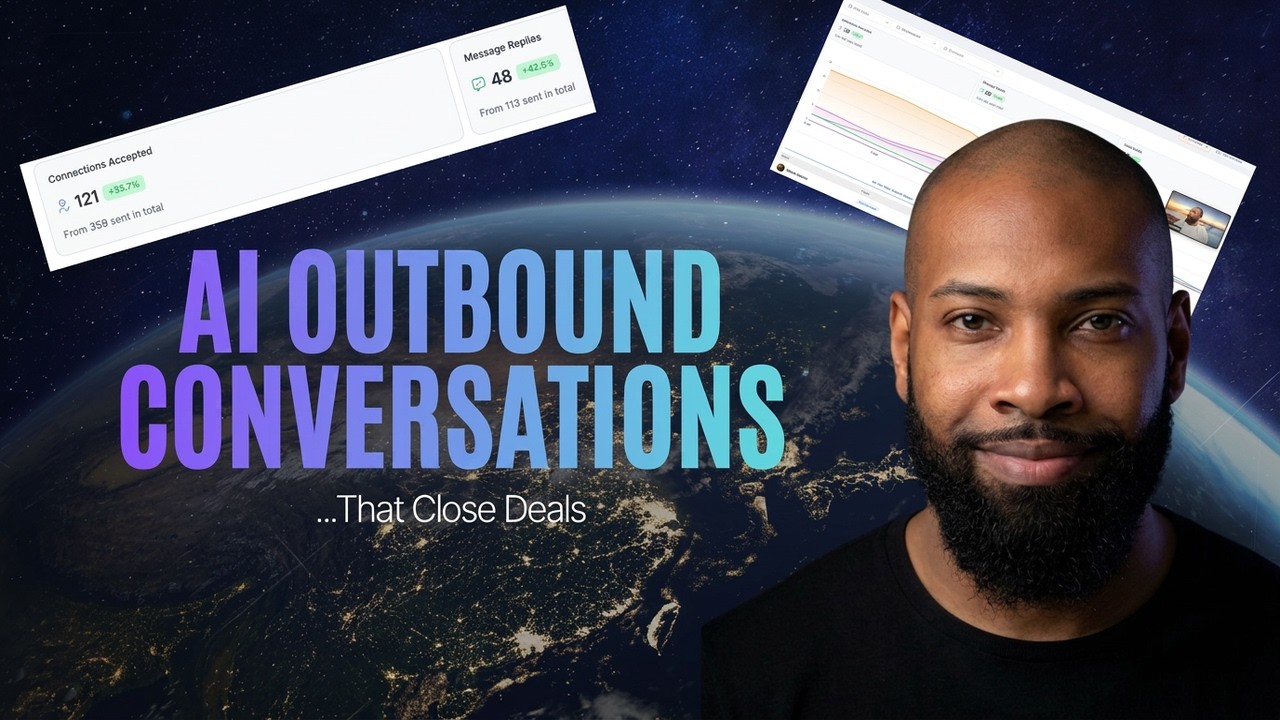
Founder Walkthrough Founder Walkthrough fallback
Click to play
Founder Walkthrough
Governed execution in practice
Pipeline Results Pipeline Results fallback
Click to play
Pipeline Results
From first message to closed deal
System Deep Dive System Deep Dive fallback
Click to play
System Deep Dive
How the governed stack runs
Commercial Intelligence Commercial Intelligence fallback
Click to play
Commercial Intelligence
Judgment over automation
The Bigger Idea

The most important thing these results prove
isn't that outbound works.

Everyone already knows outbound works. The question is why it works inconsistently — and why most attempts to fix it with more automation make the problem worse.

What these campaigns prove is that commercial judgment scales.

When timing improves — more conversations start at the right moment.
When targeting improves — fewer messages create more qualified conversations.
When progression improves — more conversations advance past the first reply.

Pipeline becomes a byproduct of all three. Not a goal you optimize for directly.

$396K
Total ARR Closed
244
Total Opportunities
4
Verticals Proven
~42%
Avg LinkedIn Reply Rate

That's the architecture ScaleMatic was built around.
Not more automation.
Better decisions.

Everything we have built since has been in service of that idea.

SCALEMATIC
Human-governed AI revenue infrastructure  ·  scalematic.io